
Harry Potter Re-Read Book 1
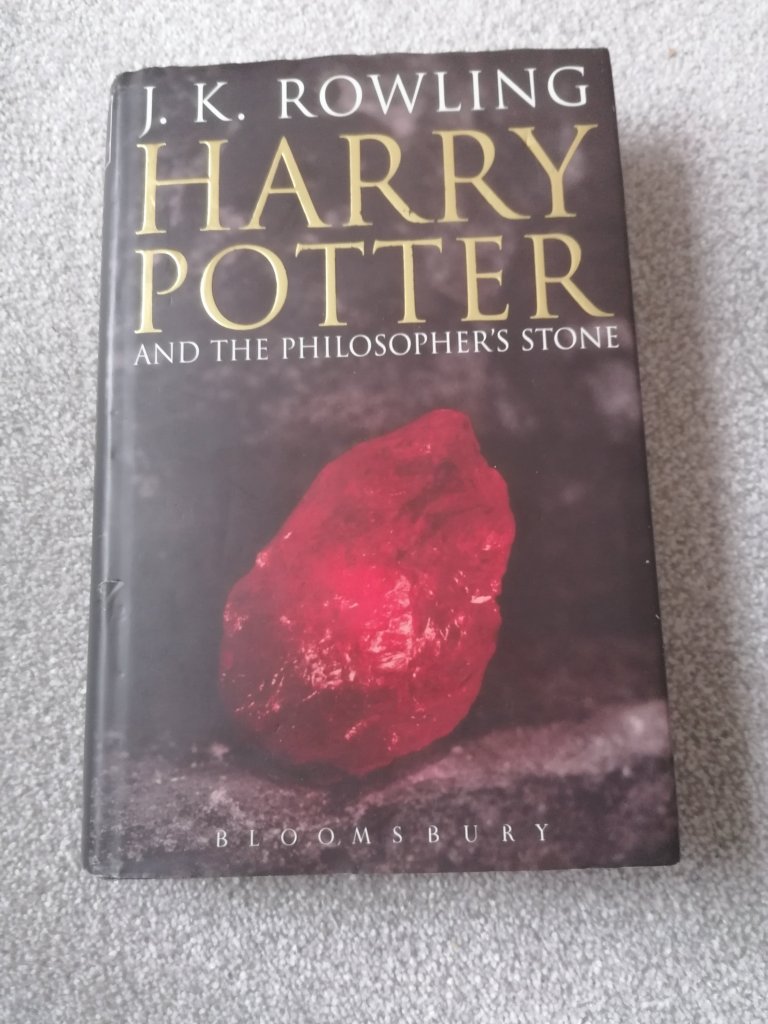
Like many parents, especially those with children in their 20s now, I spent many happy hours reading the Harry Potter series to a rapt audience. I would use all the tricks I could to keep my children engaged, making liberal use of accents, volume, tone of voice and of course cliff hangers that made them beg for one more chapter – which they often got! I didn’t read the final two as bedtime stories, because my children had reached the age where they read them for themselves. Those two came out two years apart, in 2005 and 2007, and had become very long books that really didn’t lend themselves to bedtime reading due to the very dark nature of the stories. Our family interaction with the series after that was based on the films to a large extent and I went with the children to each one, which they and I enjoyed immensely.
Recently, I came across the books again whilst clearing out as we were preparing to have a carpet fitted. I wondered how the books would come across to me now as a set of stories that I could read back-to-back without the two-year gaps. Would they still transport me? Would they still give me the same enjoyment? Were they, when removed from the context of reading to my children, any good? Well, there was only one way to find out wasn’t there? Join me as I embark upon a re-reading of the entire series 25 years on from the publication of the very first book in the series.
First up …
Harry Potter and the Philosopher’s (Sorcerer’s) Stone
The Philosopher’s Stone was a low-key release in 1997, but it quickly received a lot of word-of-mouth support and I remember getting paperback versions of this and the sequel from a newspaper offer in 1999, just a few months before The Prisoner of Azkaban was released.Things were very different in those pre-internet days!
The opening chapters
I suppose the first thing that occurred to me when I started re-reading it was how much of the books I had forgotten. The films have, quite naturally, become our vision of Hogwarts and the Wizarding World, but they have also become the default storylines and the default versions of the characters. The starting point of the whole series is Vernon Dursley, not Harry Potter. In the films he is the butt of a lot of humour, being portrayed in a somewhat buffoonish style, but in the books, he is a staid, narrow-minded and spiteful character who tries to impose his views on everyone around him. This makes him more understandable when he treats Harry so badly, and it grounds the story much more in the real (Muggle) world. The importance of this becomes clear to the reader when he starts seeing things around him that he cannot explain, and we share his sense of confusion as his ordered world refuses to conform to what it should be. The opening chapters do an incredibly effective job of building up the background to the story and preparing us for what happens next. Plotting is very much the strength of the whole series, and it makes you turn the pages briskly and read on for ‘one more chapter’! Petunia and Dudley Dursley stay very much in the background in this first book as Vernon is brought front and centre.
The Wizarding World
When Hagrid turns up, he brings the whole of the Wizarding World with him. This is not the Hagrid of the films, however, but a shrewder more calculating character who shows clearly why Dumbledore trusts him. He is our key to the back story and our key to understanding Harry’s position in the world he has been kept from for 10 years. It is a master stroke to go to Gringott’s first, because the characters of the goblins are opaque and their demeanour unsettling. Yes, we marvel at Diagon Alley with Ollivander’s and the Owl Emporium, but the goblins put us off kilter from the start. It’s very interesting that the first Hogwarts student that Harry meets in the book is Draco. Again, we notice an undercurrent, but we’re not sure what it means just yet or what has caused it. The wand that chooses Harry comes with its own story which Ollivander is only too eager to divulge. The journey on the Hogwarts’ Express introduces us to the Weasley clan, Hermione and Neville and the Sorting Hat gives us a pen portrait of the four houses in the school. Within a hundred pages the foundation of both worlds has been built. It’s a very impressive piece of writing for an inexperienced author.
The Characters
This is perhaps the aspect of the book that is the patchiest. Although the characters arrived on screen fully formed, having benefitted from three completed books to find their feet, in the novel they are functional at best. Generally speaking, their job is just to move the plot along, so they tend to have a stereotypical air. You have the hero, finding out that he is special, the best friend providing support and someone to impress and the third side of the triangle that is being set up for 6 books hence. It surprised me how peripheral Hermione was in this book, even after the troll at Halloween. Yes, she became part of the trio, but she remained resolutely on the outside in terms of the friendship. She is the know-all who can be insufferable but is OK once she has had a couple of rough edges knocked off. In some ways, her role could have been split between the other two with a minimum of fuss. Neville is intended to be comic relief with his haplessness, but we only see him being clumsy or forgetful so his act of defiance towards the end of the book doesn’t ring true. Draco is a one note villain, and his henchmen are simply there. At this stage, the staff barely have a character of real interest amongst them. Dumbledore is unknowable, which makes complete sense, McGonagall is the harsh but fair one and Snape is simply the nasty metalwork teacher we’ve all had!
This tendency towards two dimensional characters is obviously a product of the inexperience I mentioned before, but the great plus is that it doesn’t matter. The plot is the thing that keeps you reading the book and that just works from page 1 onwards. The characters will develop as the series progresses, but for now they do not clutter up the narrative and slow everything down.
Overall
It was something of a strange experience re-reading this first book so many years on, but it was an experience that reminded me of the reasons why I held this set of books in such high esteem despite its occasional weaknesses. As the opening novel in the series, it ticks all the boxes.
Discover more from David Pearce - Popular Culture and Personal Passions
Subscribe to get the latest posts sent to your email.
 David Pearce - Popular Culture and Personal Passions
That must have been a walk down the memory lane! One of the classics of all time 👍🏼
LikeLike